See http://prodeval.blogspot.co.uk/2012/04/digitisation-face-book.html and other posts on digitisation/convergence
The concept of web 2.0 is absolutely central to the philosophy of this exam board, and how the examiners perceive the media and your relationship to/with it. [see simple Ppts added to end]
The concept of web 2.0 is absolutely central to the philosophy of this exam board, and how the examiners perceive the media and your relationship to/with it. [see simple Ppts added to end]
The term is used to denote a shift from
the initial top-down, static, one-way traditional mass media approach of the
early web. Traditional 'analogue' media companies were swift to
dominate.
Web 2.0 marks a decisive shift away from such analogue models to truly new media, with the web as much produced by as consumed by
the likes of yourselves. You've all used the web for entertainment, and
accessed film for research ... but you've also all created web content
(blogs etc) and published work on the web.
Moreover, you've all used new/social media for:
- research (including on conventions and audience)
- generating ideas (for this + above point: fan forums/sites especially important)
- teamworking (sharing posts, + keeping in touch with planning)
- feedback on drafts/final cuts (blog, FB, YT, Twitter, ...? your vids have been viewed by many in the US/Can/NZ/Aus/Irl, as well as various European nations, and even the likes of Saudia Arabia according to the YT analytics data)
There are a range of theorists attached to the concept, which is useful not just for DCRUP but also the remaining 4. The term is linked to O'Reilly (2004) because he organised the O'Reilly Media Web 2.0 Conference in 2004. Sociologist and postmodern theorist David Gauntlett has adapted the term to write of Media Studies 2.0, as detailed below; he argues for a new approach to research which 'asks participants to make something as part of the research process'.
To push into the top end of marks it helps to not just cite a theory, and show how it applies to your work, but also to evaluate and critique it. The following, taken from my Q1a pack which has been available on the prodeval blog since May 2011, provides you with an example of this:
Whilst web 2.0 increasingly seems characterized by media giants providing platforms for such interactivity, the original concept was partially intended to denote a shift away from the dominance of mass media. Your work illustrates the tensions here: you’ve created new unique material, but used many mass media sites/resources to do so: Guardian for research; Blogger + YouTube … both owned by Google, which you used; Amazon, now the world’s largest book-seller, etc.The following is also taken from this same (rather good!) guide. The point from this is that you should seek to link your work, especially how it progressed through A2, into industry practice. I give several examples below, but the MusiVidz blog is full of posts highlighting uses of new media forpromoting vids/albums etc:
AUDIENCE FEEDBACK & MARKETING – How did new media help you gain aud feedback? Discuss any issues with this. Some of you got unhelpful, even personal, comments on YouTube (& probably some spam). What about Facebook? Your blog? Vimeo? Link to real world practices: the film Snakes on a Plane made considerable use of online feedback: ‘Taking advantage of the Internet buzz for what had been a minor film in their 2006 line-up, New Line Cinema ordered five days of additional shooting in early March 2006 (principal photography had wrapped in September 2005).While re-shoots normally imply problems with a film, the producers opted to add new scenes to the film to change the PG-13 rating to R and bring it in line with growing fan expectations.’ [Source: wiki – contains more useful info] Drip-feeding rushes, pre-production news (casting etc), teaser trailers etc is all part of the film biz’s buzz-creating technique (to what extent do music vids reflect such practices? The notion of ‘premieres’ at least is prevalent: C4 often heavily trail premieres of music vids)
The web 2.0 Wiki:
The term Web 2.0 is associated with web applications that facilitate participatory information sharing, interoperability, user-centered design, and collaboration on the World Wide Web. A Web 2.0 site allows users to interact and collaborate with each other in a social media dialogue as creators (prosumers) of user-generated content in a virtual community, in contrast to websites where users (consumers) are limited to the passive viewing of content that was created for them. Examples of Web 2.0 include social networking sites, blogs, wikis, video sharing sites, hosted services, web applications, mashups and folksonomies.See also http://beauchampcollegemedia.com/2011/04/07/web-2-0/ which contains useful videos on this
The term is closely associated with Tim O'Reilly because of the O'Reilly Media Web 2.0 conference in late 2004. Although the term suggests a new version of the World Wide Web, it does not refer to an update to any technical specification, but rather to cumulative changes in the ways software developers and end-users use the Web. Whether Web 2.0 is qualitatively different from prior web technologies has been challenged by World Wide Web inventor Tim Berners-Lee, who called the term a "piece of jargon", precisely because he intended the Web in his vision as "a collaborative medium, a place where we [could] all meet and read and write". He called it the "Read/Write Web". [Wiki]
http://www.alevelmedia.co.uk/page14.php contains the following vid, and highlights Gauntlett (writing about Media Studies 2.0), a useful theorist as he writes on postmodernism - a concept you can apply to all 5 DCRUP areas:
Gauntlett launched his own Media Studies 2.0 website to highlight the key theories/concepts he considers part of the changed Media Studies teaching/learning environment: http://www.theory.org.uk/mediastudies2.htmDavid Guantlett, who is a reader in Media Studies, recently categorised this term, read the full article here. Summary points below:
A range of further resources are hyperlinked here: http://webdesign.about.com/od/web20/Web_2_0.htm
[ORIGINAL POST BELOW]
This is an article which gets right into issues around web 2.0 (tho' its not for a media studies audience, but a newspaper, so it doesn't use theory terms or jargon); the rise of the amateur or fan film-maker and how new media is making such people (as you!) into serious contenders drawing in serious audiences...
Note: I've added some emphases (highlighted some passages in bold)
SOURCE: http://www.guardian.co.uk/film/2010/may/13/fan-films-wes-anderson-spiderman
The new wave of fan films
A couple of clicks away on the web are scores of films made by fans – by turns hilarious, ingenious and ambitious. Lurking among their makers might be Hollywood's next generation.
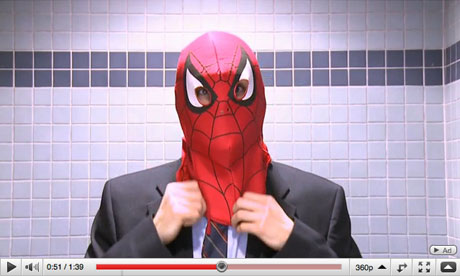
Wes Anderson Spider-Man … 750,000 viewers and counting
The idea of the fan film – an amateur, not-for-profit work inspired by a commercial movie, TV show or comic book – isn't new. Even before science fiction conventions in the 1970s began to provide sizeable audiences for homemade homages to much-loved sci-fi/fantasy franchises, teenage movie geeks such as Hugh Hefner and Batman fan Andy Warhol were finding their film-making feet making short and shaky tributes to their favourite flicks.
What has changed, in ways that could have a serious impact on commercial cinema in the next decade, is the level of quality, professionalism and ambition in the cream of the contemporary fan-film crop. The wide availability of cheap and portable high-calibre equipment, instant distribution through the internet,
and the increased involvement of acting and film-school graduates, means that the most popular offerings are no longer characterised by (in the words of veteran fan film-maker Larry Longstreth) "some goofy dipshit with access to a few costumes on the top of a parking deck". They're just as likely to be sharp, witty, original pieces of work with impressive production values and strong performances.
These films take themselves, and their audiences, very seriously, and find reward in doing so. Some of them, like last year's highly ambitious Lord of the Rings prequel, The Hunt for Gollum, were preceded by a number of teasers and trailers "announced" online before the film's unveiling – in Gollum's case at the Sci-Fi London film festival. Many of them – like the full-length, lovingly rendered Return of the Ghostbusters – will be screened in independent cinemas as part of fan-organised events all over the world. Academy Award Winning Movie Trailer, a clever, knowing, and very funny parody of the Oscar-chasing Hollywood promo, made by a couple of film-school graduates in Atlanta, had half a million hits on the first weekend it went up on YouTube in March – that's 499,989 more people than went to see Uma Thurman in Motherhood on its opening weekend in the UK.
Of course, fan films are first and foremost a way for obsessives to participate in the life of their favourite films. The fan film, whether it's a camcorder version of Star Wars starring Lego figures, or a highbrow HD vision of The Seven Samurai Part II, is motivated by similar instincts as the urge to collect autographs or host the local Marilyn Monroe lookalike contest. Essentially it is an expression of love and a desire to attach yourself to the post-release narrative of a movie. For some enthusiasts, the best fan films satisfy the parts Hollywood films often can't reach – and the studios' increased use of long-running promotional virals suggest that they're beginning to understand the value of forming relationships with their audience that go beyond the two-hour running time of the film itself.
"There's definitely a very honest connection between the amateur film-maker and the audience," says Nick Kocher, one half of Britanick, the team behind Academy Award Winning Movie Trailer. "That's part of the reason why sometimes internet videos become more popular than films in theatres. There's nobody over your shoulder telling you that you can't do something, or a certain choice isn't appropriate, or isn't marketable. When money's out of the way like that, very real and engaging stuff can be made. Not to sound like we're devaluing Hollywood movies, but there's a great sense of camaraderie between amateur YouTubers and the fans – like they're going up against the rest of the world together."
Jeff Loveness, a 20-year-old film student in California, whose Wes Anderson Spider-Man – a whimsical imagining of the web-footed superhero's next chapter in the hands of the distinctly undynamic indie director – has been viewed by around 750,000 people since he posted it on YouTube in February, agrees. "Sometimes the lack of budget combined with the quality of material is heartening for viewers, and it makes them feel very connected to the film," he says. "They know it's a regular guy who made it. Advances in technology mean we're getting closer to when ordinary people will be able to make studio-style films, but they'll have this personal factor to them, which will draw them closer to their audience because they won't feel like this cold, test-marketed, focus-grouped product."
For Stuart Cosgrove – Channel 4's director of nations and regions, who is heavily involved in supporting digital media users – films like Loveness's are the logical result of a marriage of two prominent contemporary cultural trends. "Often these films tap into a very current trend of spoofing or culturally undermining official, established media images," he says. "We saw that throughout this election, with every poster image being spoofed and morphed and Photoshopped because the means to do it exists. It's becoming a real subculture online. Add to that the punk-born DIY ethos – participate rather than just watch – and a new reality in which distribution is more porous and invasive, from the many to the many rather than the few to the many. The Just Do it culture is flourishing."
It's certainly true that, while some fan films are still little more than slavish reproductions of sci-fi and fantasy classics like Star Wars and Star Trek, many are more interested in engaging with the wider film and media culture, commenting on cinematic style, movie cliches, film marketing and the mores of fan worship in general. From the low-budget, brilliantly observed work of Brandon Hardesty, with his quirky "celebrity re-enactments" (Woody Allen and Arnold Schwarzenegger team up for The Silence of the Lambs, Christopher Walken and Jack Nicholson for Willy Wonka and the Chocolate Factory), to the highly polished satire of New York sketch group Elephant Larry, fan films have come a long way from two fat blokes with beards running through a forest waving pound-shop light sabres.
The big question is what happens next; it could get very interesting. Among the current set of fan film-makers, there are likely to be a good number of the next generation of both Hollywood luminaries and indie darlings. Loveness and the Britanick boys are typical of the scene's most promising new stars – film students in their early 20s, who are steeped in the language and methodologies of cinema, constantly honing their craft while the attention their work has attracted helps them make contacts in the industry. Aspiring comedy writer/director Loveness is now writing for celebrated satirical website The Onion, while Kocher and his partner Brian McElhaney have roles alongside Heroes' Masi Oka and Battlestar Galactica's Michael Hogan in Andrew Disney's directorial debut, Searching for Sonny. As far as they're concerned, the YouTube learning curve has not only helped them sharpen up their approach and develop their personal styles, it's cemented some strongly held convictions that will inform their future forays into commercial cinema. "The new film-makers are going to know that you can't waste a second on film," says Loveness. "You learn the importance of setting up an intriguing question, or a great title which attracts attention. Online, you don't have the captive theatre audience – the challenge is to keep them watching, but not just by throwing in easy crude jokes. I worried with the Wes Anderson spoof: it was so packed with subtle references and jokes, I didn't know if anyone else was going to get it. But that film found its way to so many people who completely understood it and connected strongly with it. For me, it proved that you don't have to think in broad strokes to find a decent audience, they will find you."
Kocher and McElhaney are convinced of the same thing, insisting that YouTube has taught them "you don't have to give up personal integrity to get an audience". They are also determined to keep a firm grip on the artistic reins, regardless of how many ballbusters try to entice them into the business. "What makes us us is that we write, direct, act and edit all of our own stuff," says Kocher. "We're ready to really fight for that. People like Ricky Gervais proved he could do that with The Office. The Coens proved they could right from the start too, before they had any money; so when they got a budget no one questioned them having full control. We're using YouTube to prove we can do the same thing. We're earning our stripes."
Ten of the best from the new breed of fan films
Academy Award Winning Movie TrailerNick Kocher and Brian McElhaney took 10 days "from first draft to final edit" to compose this well-crafted parody of Hollywood trailer clichés and have seen their stock rise; the two million people who have seen the film include Ashton Kutcher and Roger Ebert.
See it: bit.ly/b70pRr
Wes Anderson Spider-Man
This trailer for the new Spider-Man – if Anderson were directing – was inspired by 20-year-old student Jeff Loveness's passion for "absurdist" comedy such as Monty Python and The Office.
See it: bit.ly/by7bwa
The Hunt for Gollum
Despite its paltry budget of £3,000, British computer engineer Chris Bouchard's Lord of the Rings prequel is seriously slick. The 40-minute-long work has notched up more than 5m views.
See it: bit.ly/BSoVy
Celebrity Re-Enactment #1: Willy Wonka and the Chocolate Factory
Comedian Brandon Hardesty has posted a number of "re-imaginings" of famous scenes with alternative lead actors (he impersonates all of them). This is the most successful; the notion of Christopher Walken as Charlie's outraged grandfather squaring up to Jack Nicholson's severely vexed Wonka is inspired.
See it: bit.ly/9lCbUk
Mafia
New York comedy team Derrick's mafia movie parody probably over-stretches the joke, but the skill involved in this 3-minute 22-sec single take is striking. The team premiered their first feature film, Mystery Team, at Sundance last year.
See it: bit.ly/LvpXV
Return of the Ghostbusters
A full-length homage described by director Hank Braxtan as his "fan film magnum opus". The makers of the official Ghostbusters videogame liked it so much, they gave it a cameo in the game.
See it: bit.ly/19OzHw
DVD Commentary: The Movie
There are numerous movie pastiches on New York comic sketch group Elephant Larry's site and they're all well worth a viewing. This postmodern pastiche of DVD extras commentary, delivered by the actors as they perform the scenes, is particularly well done.
See it: bit.ly/cse7ww
Losing Lois Lane
This charming, very low-budget short from Louisiana's Blayne Weaver shows us the Superman we don't usually see – a pathetic loser who spends his days mooning over pictures of the girlfriend who has just dumped him. Weaver's first feature film, Weather Girl, debuted at the LA film festival last year.
See it: bit.ly/2Zehv9
Grayson
Director/writer/actor John Fiorella's "trailer" for an imaginary film about DC comics character Dick Grayson is one of the internet's most popular films, with more than 9m views since its release. Director/writer Fiorella has supplied an entire screenplay for the non-existent full-length film on his website.
See it: bit.ly/OJyyf
Batman Dead End
Sandy Collora's 2003 film is considered by many to have heralded the fan film's advancement on to a new level of sophistication. Clerks director Kevin Smith called it "possibly the truest, best Batman movie ever made". Collora is currently working on his first feature film.
See it: bit.ly/EvgN2
By Charis Creber:
...

No comments:
Post a Comment